







Dubai, 1990
I leave for college in New York next month so my sister, Shireen Apa, has decided I should be taught the essentials of survival. We’ve had mend-your-clothes-by-hand day. How-to-dissuade-a-man day. How-to-disable-a-man day. How-to-treat-wounds. How-to-disappear. How-to-resurface.
Today is how-to-make-rotis day.
“I know,” Apa says, “I know, it sounds old fashioned, Noreen. But, baby sister, there is a hunger as deep as a well in people like us; one that only a flaky roti right off a hot tawa will satisfy.”
She takes great care not to make me think she wants me to be a housewife. She isn’t one herself. She manages a bustling salon in the heart of old Dubai. But it’s an unspoken hope amongst the working girls here: a life of respect.
Apa has aspirations for a professional future for me, higher even than I dare imagine. She holds me responsible only for the state of our bedroom and my desk, because, presumably, a clutter-free environment is important for my studies. She insists we house with the other salon workers so we can save for my college, all three of the other girls in one room and Apa and me in the other. Nana, our grandfather, forced me back from Lahore to finish school here, unable to keep me because he had no home, had lost it in a game of poker, of all things. I have nothing to teach you, he’d said.
Since I returned to Dubai, I’ve managed to evade this airless fifty-square-foot kitchen. Battered pans from four different countries totter in a stack: the Filipina’s kawali, the Sri Lankan’s thatthchiya, the Bengalan’s hari, Apa’s karahi. They’re all round pots for God’s sake, but each girl simply must have the one her mother used. They’ve come to look exactly alike, the grease stains on their outsides from the same colossal can of sunflower oil we pitch in for. The pantry is choked with communal dried milk containers rattling with beans and reused jam jars stained with the pigment of spices. I’ve learned to shut up about the creak of the cobwebbed exhaust fan because the girls all feed me, somehow of one mind that I get the higher education they never could. I also shut up about the midnight cockroach on the floor drain, the sunrise lizard on the single sooty window.
Nana threw me back on Shireen Apa who’d been too spineless to defend me against our aunt, that old prude Ghazala who’d accused me of lasciviousness when Apa and I lived with her, and sent me back to Pakistan even though I was almost done with high school. But Nana assured me my return to Dubai would pass like a storm does; he told me to be patient and not offend the fortune that came my way. Make use of it, he said. Your aunt, your sister, they’re steppingstones. Your mother had all your potential, Noreen, but not your luck.
Nana had always loved our mother more than his older daughter, Ghazala. I was only nine when our mother died – she’d been screaming at our father again that day. Next thing I knew, Shireen Apa forced me into a cupboard full of moth-bitten clothes and then dragged me through our empty cottage and ran with me all the way to Nana’s house. No one has told me how our mother died, though I’ve always known not to look for our father. They say he ran away that day.
What if he ran from grief? What if he was lonely without his wife and daughters? He’s dead to the family, they told me. And then news came recently, in the short time I just spent with Nana, that our father had finally died – taking a new wife and their infant daughter with him, leading them far down a train track outside the dusty town they lived in, tying them both down and throwing himself on top of them. That is the act of a broken man who loves his own fiercely. Maybe too fiercely. Maybe I could have saved him – if they’d let me look for him all these years. But I’ll never know.
So, I look now only to my own future, as Nana has told me to. No one understood my father. No one will understand me. I wait by the pocked aluminium tray we use for kneading our various daily breads.
Apa drags the jumbo sack of flour from the pantry. Reaching above the stove, she tugs the string on the exhaust fan. It dangles a few inches too high for her. I could reach it, but why bother with something she does every day anyway. I steel myself for the smoke that will soon invade my nostrils because that fan is a flop.
“Stone-ground wheat is the best,” Apa tells me. “God knows what you’ll find in America, though.”
I jiggle the flour she’s measured out in a sieve positioned over the aluminium basin. I imitate the wrist movements she shows me; still, a fine powder spills over the sides.
“Keep going,” she says. “Will you believe what our mother said when she was teaching me? The chaff will make your roti ragged, and then who will marry you?”
She brings me a cup of hot water from the sink. “Work in the hottest water your fingers can bear,” she says. When I wince at the heat, she winces too. She reaches as if she might mix in the water for me, but then pulls back, telling me instead, “Our mother used to say the hotter the water the softer the roti, so the scald will be worth it.”
When I manage to pull together the first crumbs of a dough, she tells me to gather them and knead. “With a determined fist,” she reminds me, over and over again. Then, with a gentle touch on my clenched hands, she stills me. “Give it time now,” she says. “Let it relax its fibres.” We wait together, my eyes on the dough, her eyes on me. “Our mother told me how, after such a beating, rest makes dough pliable. She warned me to remember this.” I know the wait might be at least half an hour. I’d never wondered what Apa did in that half hour every day. “I’ve thought about her words on this matter,” Apa carries on, her eyes faraway. “It was years before I understood why she called it a trick.”
We reminisce about the games we used to play with our mother’s pots and cooking utensils; the bites of our own food we secreted away in our dupattas for our dolls’ weddings. Usually, our mother scolded us for that. But the day before we ran, the day before she died, she had helped us sew new dresses for our dolls. From a torn kameez of hers. I was surprised at the rips in that kameez – it was a new one she’d recently sewn. I think to ask Apa about that kameez as we wait. But then I decide I don’t want to know. It’s been too long.
We make a dozen balls of dough together. “Tear off only what will fit in your hand,” Apa warns, showing me. “More will only be trouble, our mother used to say.”
We don’t call her “Ammi” like we used to when we were small. For years we didn’t speak to each other about her, and others referred to her as “your mother.” Later, she simply became “our mother.” That way, we stopped pining for the times we could speak with her.
Apa motions for me to bring the rolling board and pin from the rack above the counter. She sprinkles some loose flour on the board and hands me a dough ball. “Okay, roll it into a perfect circle,” she says and chuckles when I throw her a look of betrayal. “The first time I made rotis,” she says, “our mother said to me the circle must be perfect. Here, you are on your own.” Apa added a nasal tone to that last line, which takes me aback. It is our mother’s voice; one I had forgotten the sound of.
I flatten and roll out the dough with too much care and not enough pressure. Apa leaves me to my attempts and strikes a match. She lights an open flame, and then another one under the griddle.
“When the tawa is hot enough,” she says, “lay your roti on.”
“How hot?” I ask.
“Throw on a pinch of flour. It should toast, but not scorch.”
She hovers a palm over the tawa for a few seconds, then nods. I drop my crude disc onto the griddle.
“When the first side blisters, flip it and let the other side cook, but only barely.” As the second side of my roti turns opaque, Apa is on her toes. “This is your moment— flick the roti onto the open fire.”
For a fleeting moment, I’m on the verge of tears, terrified of failure, convinced the flame will spitefully turn to ashes the half-done bread I’ve smothered it with.
But then, the layers of my roti begin to flake. They rise up with the breath of the kitchen, ballooning the roti right up to its spherical edges.
Apa lifts my roti off the flame with her bare hands and places it in my open palms. “Our mother used to say,” she says, making me look her in the eye, “if you’ve done everything right, you’ll hold the world in your hands. Do not let it burn.”
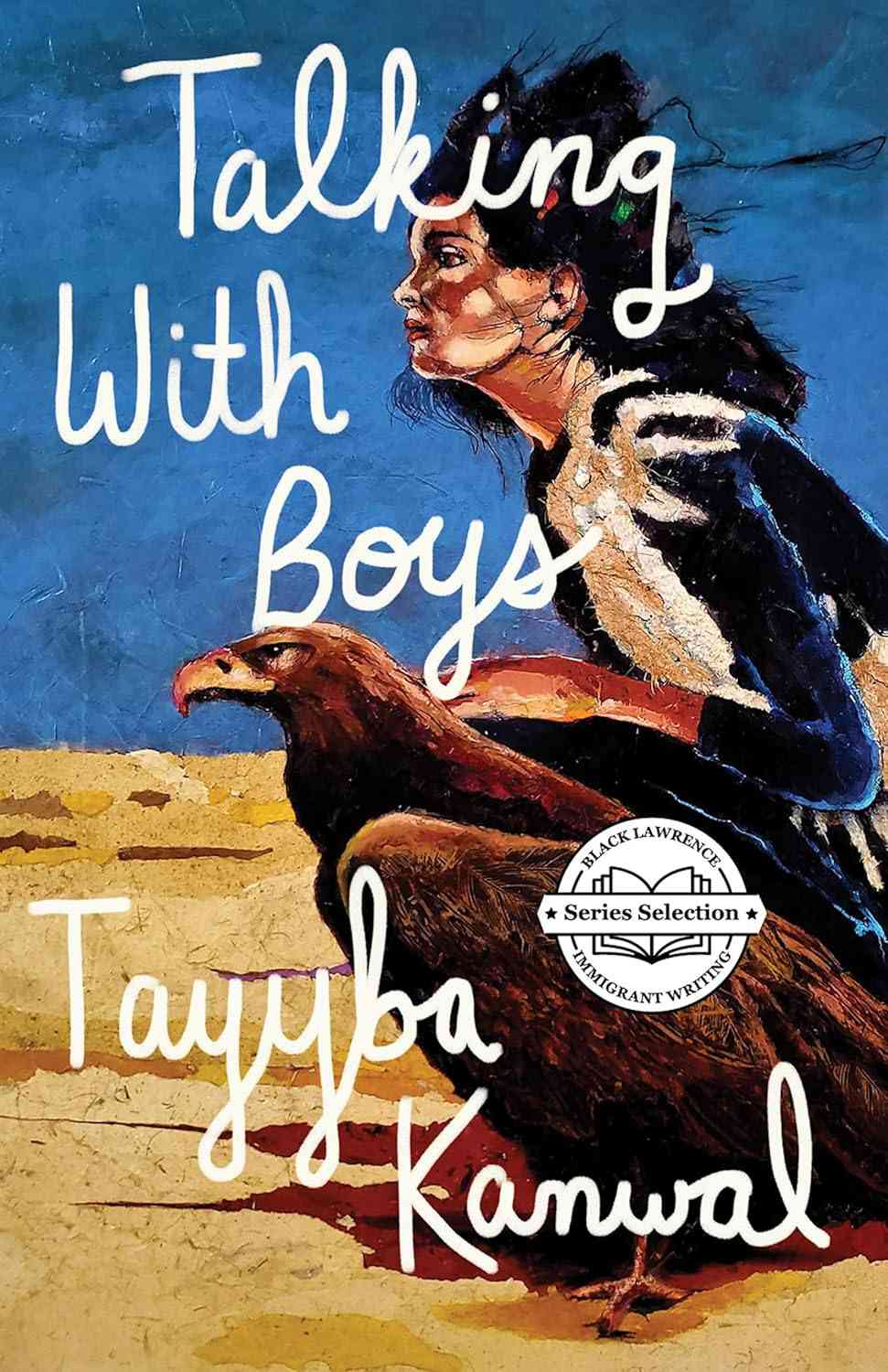
Excerpted with permission from Talking With Boys, Tayyba Kanwal, Black Lawrence Press.
